

Hello Mothr.
On matrescence, inheritance, and the things we're allowed to outgrow.

If you've ever really wanted to be a mother, you probably know how much it can take over. For me it was years of get pregnant, be pregnant, breastfeed, recover, get pregnant again. Something in me rearranged, and it was all-consuming. That was just how it was.
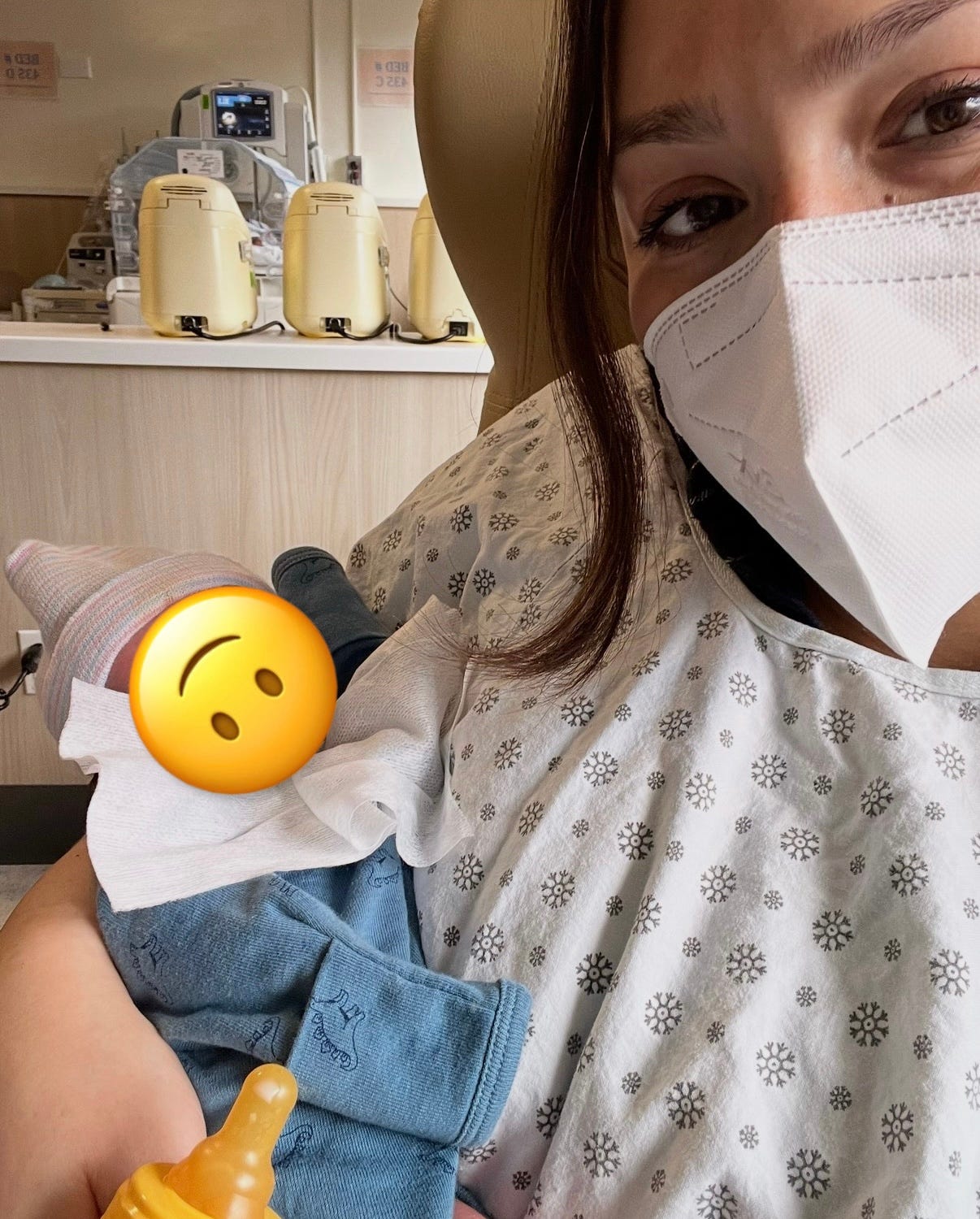
I think about the NICU a lot when I think about where this all started. My twins came early. My entire existence was reduced to a chair next to two isolettes, a hospital badge, and a pretty strict pump schedule I never missed. It was the hardest thing I had ever done. It was also, in a strange way, the clearest my life had ever been. There was no ambiguity about what mattered or what I was supposed to be doing with my hours. Get to the hospital. Pump. Hold a hand through a porthole. Wait for a number to go up. Go home. Do it again.
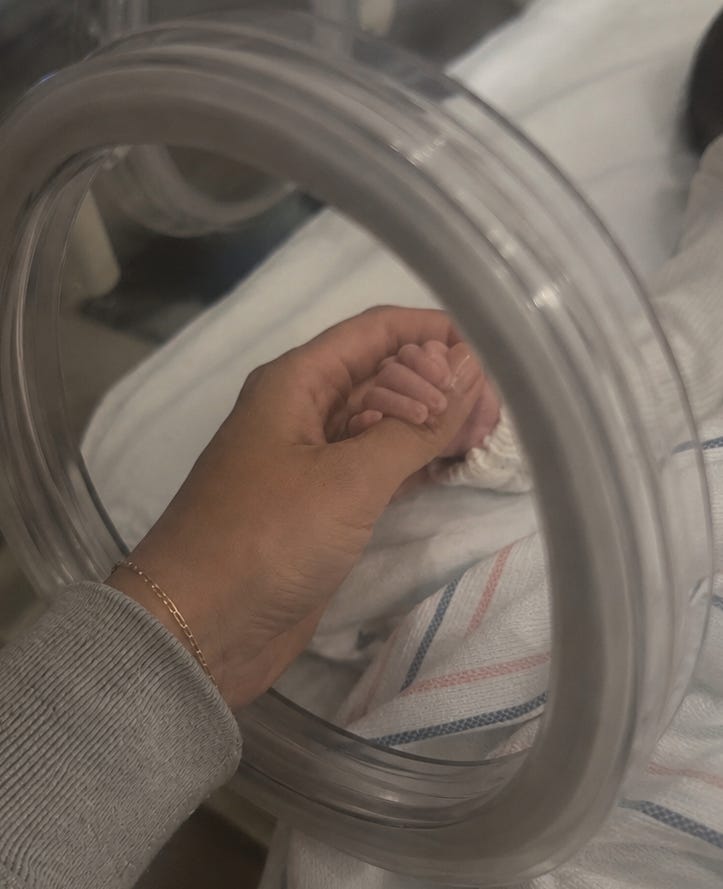
When we finally brought my sons home and then, a couple of years later, when I had my daughter — I expected the disorientation of new motherhood. What I didn’t expect was what came after the disorientation lifted. There was no next trimester. No next feeding schedule to white-knuckle through. No next milestone with a name. Just me, on the other side of all of it, supposed to feel like myself again.
I didn’t.
Not in a crisis way. I had three healthy kids, a husband, a life that looked — and largely was — good. I wasn't drowning. I was just quietly disoriented in a way I didn't have a name for, in a way nobody around me seemed especially interested in naming either. I'd ask other moms, carefully, almost as a test "do you ever feel like you don't totally know who you are right now?" and get a sympathetic nod, maybe a "totally," and then the conversation would move on to nap schedules. I kept circling the same question: I'd just gone through this massive shift, and now what? I was forever different. I couldn't go back, and I didn't want to. I just couldn't articulate how I felt, or why.
The medical system was done with me at six weeks. The people around me loved me, and the conversation was still just “are you sleeping” and “how’s the baby.” Nobody asked who I was on the other side of becoming a mother three times over, after years where my body had been the main character of my own life and was suddenly, instructively, not anymore.
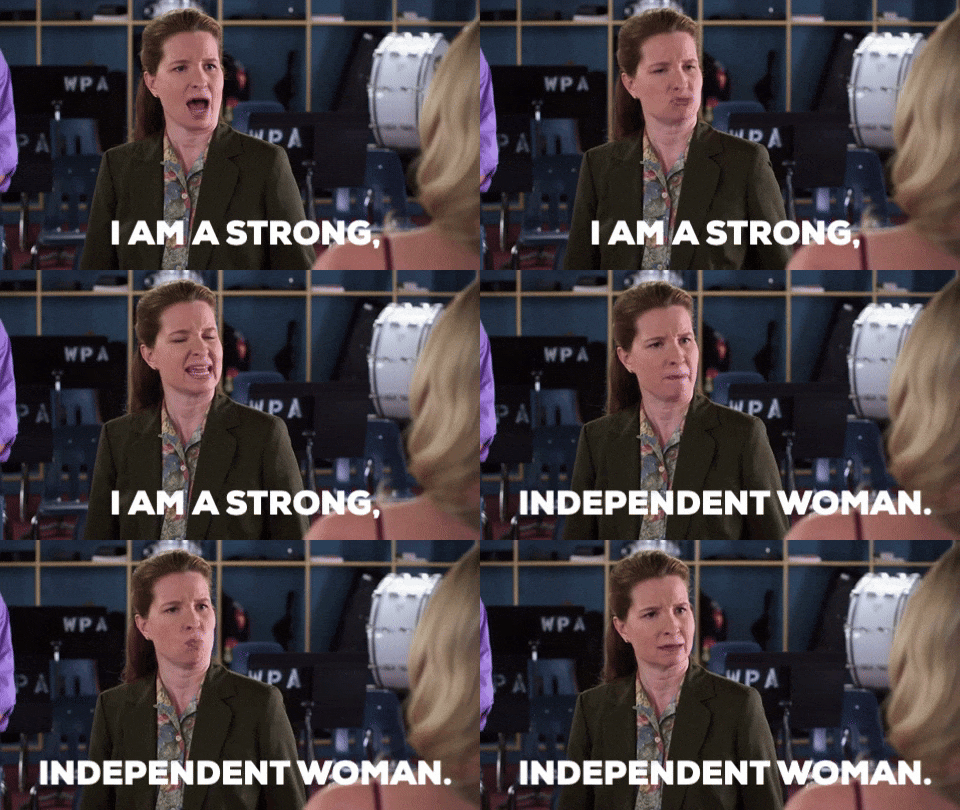
I didn’t go looking for a company. I went looking for an answer to that question. I read everything I could find. Most of it was either clinical — checklists about pelvic floor recovery and sleep regressions — or vague in that soft-focus Instagram way, all language about “honoring your journey” with nothing underneath it. Nothing addressed the actual thing: that I had spent half a decade in a body and a life defined by pregnancy and babies, and now that chapter had a back cover, and I didn’t know what the next one was supposed to be about.
So I started writing about it instead, first just for myself, then on Substack, then to anyone who’d read it. And the response told me something I hadn’t expected: it wasn’t just me. Women were emailing me paragraphs about feeling exactly this, almost word for word, like I’d somehow described a room they thought only they were standing in. That was the actual spark — not a business plan, not a market gap I’d identified on a spreadsheet, but the slow, undeniable realization that an entire population of women was disoriented in the same specific way I was, and nothing built for mothers was actually addressing it.
That’s Mothr.
I want to be honest about what building it has actually looked like, because it has not been a straight line and it has not, most days, felt like main-character energy. I have built things I had no business building. I, along with my two co-founders, have learned what a screener flow is and then rebuilt it nine more times. We have sat with a trademark attorney trying to understand language we never had to know.
For me, I have had moments of real doubt about whether I was the right person to be doing this at all, given that nothing in my background — not my degree, not my career, not my training — pointed toward "co-founder." I have done a lot of this badly before doing it less badly. I'm still doing plenty of it badly. I've made my peace with that being part of it, not a sign I'm in the wrong place.
Here's what I want my kids to see in that, more than any one accomplishment: their mom found a gap in her own life, got curious about it instead of just enduring it, and decided that curiosity was reason enough to build something even without the resume for it. You don't have to be the most qualified person in the room to go after the thing that's pulling at you. You just have to want it badly enough to keep going while you're still bad at it.
I also want them to see something else, something I think we get backwards a lot: being good at something, even being destined for something, is not the same as it being yours to keep doing forever. I grew up in a family that's been in the same industry for generations. It was, in a real sense, already chosen for me before I had much say in it. And I was good at it. I loved it. At twenty-four, it fit who I was, what I valued, the life I was building — it was exactly right for that version of me, and I don't say that with any irony or distance. It was real.
But thirty-eight is not twenty-four. My priorities have changed in ways I couldn't have predicted at twenty-four, even as I sat there being certain I had it figured out. My sense of what I want my days to be made of has changed. The things that feel urgent to me now — the gap I went looking to fill, the women emailing me their own version of my own disorientation — didn't exist for twenty-four-year-old me, because I hadn't lived the years that would make them visible.
I'm learning, slowly, and not without some real grief, that the things we love don't owe us permanence, and we don't owe them permanence either. You can be proud of something, genuinely, unambiguously proud, and still feel the pull toward something else entirely. You can have built a life around a thing, watched your family build generations around it, and still, at thirty-eight, feel a different kind of pull and trust it. Outgrowing something isn't betraying it. It's just what happens when you keep living and keep paying attention to who you're actually becoming, instead of who you assumed you'd stay.
Mothr. is the first thing I've built for the person I am now, not the person I was at twenty-four, and not even, really, the person I was before the twins, before the NICU, before any of this. It's harder than almost anything else I've done. Some days I'm still not sure "good at it" is the right frame for where I am yet, and I'm trying to be okay with that being true for a while longer, trying to let "still learning" coexist with "doing it anyway," instead of treating the first as a reason to stop.
But it's mine in a way nothing else has ever been, because I chose it at thirty-eight, with open eyes and a fuller, harder-won sense of who I am, not because it was waiting for me at twenty-four with my name already on it.
That’s the thing I actually want to model for my kids, more than any single milestone Mothr. does or doesn’t hit. Not “follow your passion” that phrase has been so flattened by Instagram captions that it barely means anything anymore, and I don’t think it was ever quite true to how this actually works. Something closer to this: you’re allowed to change. You’re allowed to outgrow the thing you were destined for and reach, without guilt, for the thing that’s actually calling you now. You’re allowed to be bad at something new for a while if it’s the right something. Choose the hard thing you love in this season of your life, not the thing you were promised in an earlier one. Let that be enough of a reason to keep going.
It has been, for me.
Honestly yours,
Michelle

P.S. Here is my ask: if any part of this felt familiar — the disorientation, the feeling that no one’s quite asked who you are now, the wondering whether you’re allowed to want something different than what you were “supposed” to want — I’d love for you to share this with someone who needs to hear it. If you want to know more about what we’re building, you can join us at Mothr.
And if this stirred something in you, I’d genuinely love to hear it. Hit reply and tell me your version of this. I read every single one. 🙃
Follow Mothr. on IG @hellomothr_
Congratulations, this is a big one. And truthfully the part nobody preps you for is, what, ninety percent of it? Everything stops at the birth like that’s the finish line and not day one of the weirdest transformation of your life. Glad it exists now.
This resonated deeply. I spent years in the cycle of pregnancy, babies, and recovery, and I remember feeling so disoriented when there wasn't a next milestone to survive. We spend years becoming mothers, but very few people talk about becoming ourselves again afterward.
Thank you for putting words to something so many mothers feel but rarely say out loud. And I'm so excited for the much-needed Mothr platform. I have a feeling it's going to help a lot of women feel a little less alone in this season of life.